



Article by BestBrokers
In early 2026 it was announced that BYD overtook Tesla as the world’s top EV seller, escalating what has become a global two-horse race defined by scale versus efficiency.
While BYD continues to dominate in sales across Asia and Europe, Tesla remains structurally different, operating with significantly fewer employees and a higher revenue-per-worker model despite lower production volumes. In light of this, I am reaching out with a new report, which highlights the automotive companies generating the highest profits per employee.
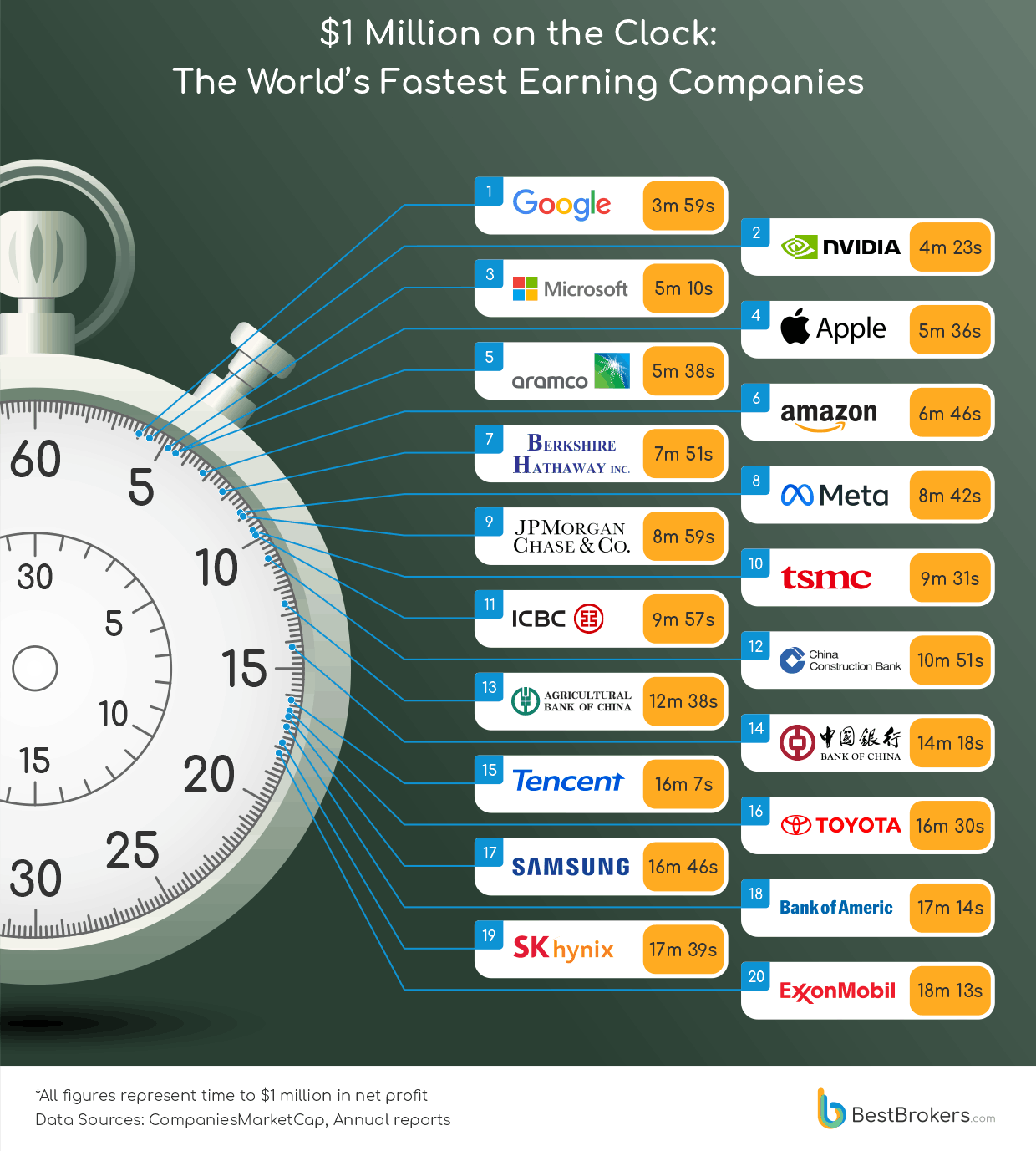
For this analysis, the team at BestBrokers gathered financial data on the 200 largest public companies by market capitalisation, sourced from Companies Market Cap, and conducted extensive analysis of official annual reports to calculate revenue and net income per employee. These annual figures were divided by total headcount, with companies ranked accordingly, alongside an additional metric estimating how quickly each firm generates $1 million in net income. The complete dataset is available on Google Drive via this link.
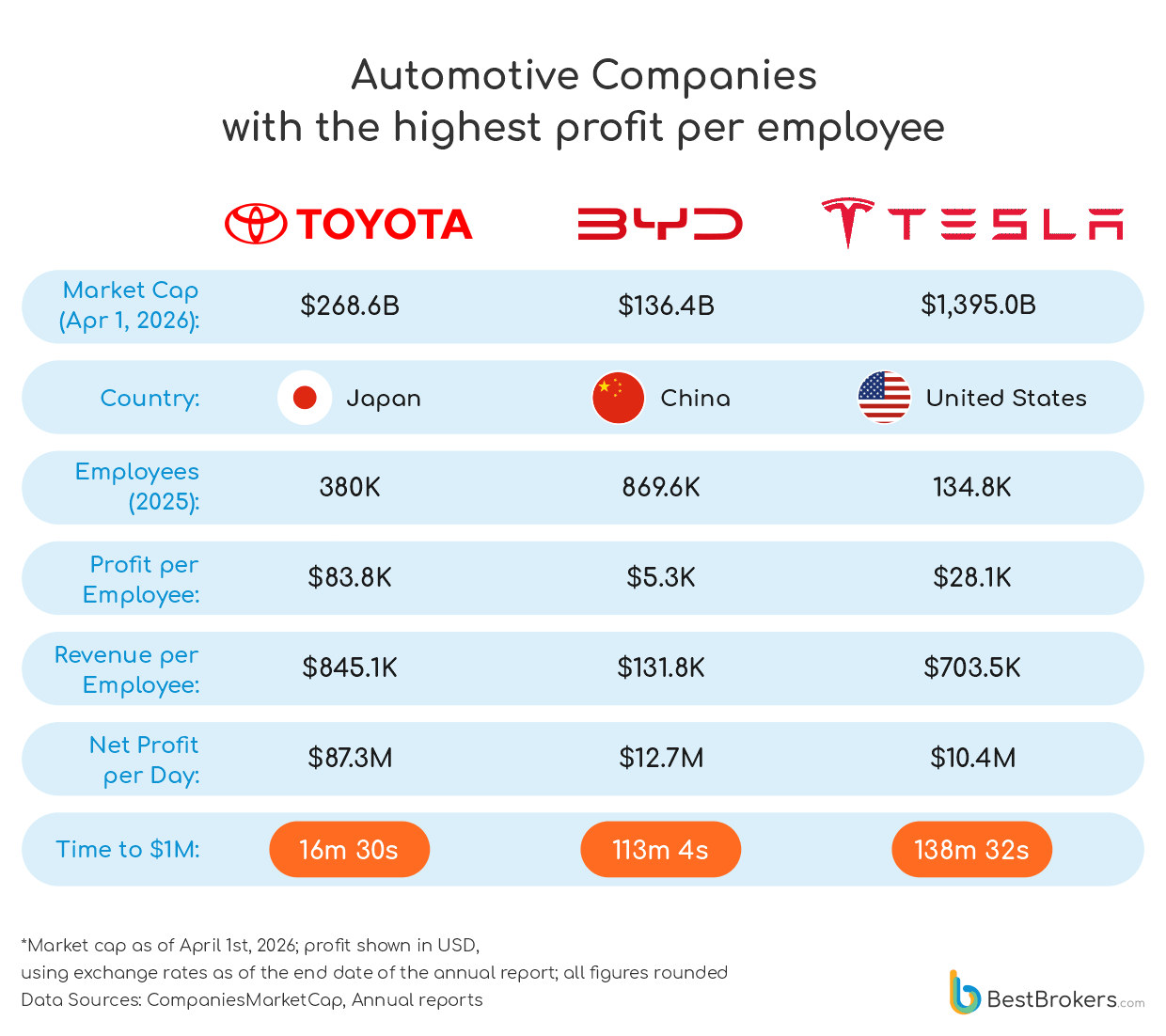
Among the 200 largest companies in the world by market capitalisation across all industries, only three automotive manufacturers appear: Toyota, Tesla, and BYD. Japan’s Toyota leads in per-employee efficiency, generating approximately $83,834 in profit per employee and earning $1 million in net profit roughly every 17 minutes, reflecting its highly optimised global manufacturing system and decades of incremental operational refinement.
However, the more revealing comparison emerges between Tesla and BYD, where two different business models collide. Tesla generates approximately $28,149 per employee, more than five times BYD’s $5,346, highlighting significantly higher labour productivity and capital efficiency on a per-worker basis.
Here are a few key takeaways from the report:
- Toyota is the most efficient automotive company on a per-employee basis in the analysis, generating $83,834 in profit per worker and $845,146 in revenue per worker. This places it well ahead of both Tesla and BYD in operational productivity, despite being the oldest and most established manufacturer in the group. Tesla sits in the middle, with $28,149 profit per employee and $703,543 revenue per employee, showing relatively strong output per worker but still significantly below Toyota. BYD ranks last by a wide margin, earning just $5,346 in profit per employee and $131,756 revenue per employee, reflecting a far more labour-intensive and scale-driven operating model with lower per-worker productivity.
- While Toyota is also the fastest profit generator, producing $1 million in revenue in roughly 16 minutes 30 seconds, Tesla is the slowest of the three, taking about 138 minutes, which is over 8 times longer than Toyota. BYD sits in between, generating $1 million in approximately 113 minutes, or about 7 times slower than Toyota. Despite BYD’s massive scale and Tesla’s high valuation, Toyota remains significantly ahead in the speed at which it converts work into profit.
- Tesla and BYD represent two very different ends of the same EV scaling spectrum, both in efficiency and profit generation speed. Tesla generates $28,149 in profit per employee compared to BYD’s $5,346, making it roughly 5.3 more profitable per employee, resulting from its far smaller workforce (134,800 vs 869,600 employees). This gap also appears in revenue efficiency, where Tesla produces $703,543 per employee versus BYD’s $131,756, or again over 5 times higher revenue productivity. In terms of profit generation speed, Tesla produces $1 million in approximately 138 minutes, while BYD does so in 113 minutes, meaning BYD is noticeably faster in aggregate profit generation, primarily due to its significantly larger scale rather than higher efficiency.
- Tesla operates as a high-margin, capital-efficient manufacturer where smaller output is offset by stronger per-unit economics and higher monetisation per employee. On the other hand, BYD relies on extreme scale, with nearly 6.5 times more employees than Tesla, allowing it to generate substantial total profits despite much lower efficiency per worker. As a result, Tesla leads decisively in productivity metrics, while BYD only overtakes it in raw speed of profit generation due to its workforce size advantage rather than operational efficiency.
‘The rivalry between Tesla and BYD has increasingly shifted from pure delivery competition to a split between profitability strength and scale dominance. Tesla continues to post strong demand momentum, including a 39.4% rise in Chinese-made EV sales in May, but its $1.5T+ valuation remains heavily reliant on expectations around autonomy and AI rather than current automotive fundamentals. BYD, meanwhile, is reinforcing its position as the new global EV sales leader, expanding exports across Europe and emerging markets while aggressively pushing battery and ultra-fast charging technologies to strengthen its cost and infrastructure advantage.
Overall, Tesla is being priced as a high-margin, future-technology platform with strong brand demand but slower relative scale growth, while BYD is increasingly operating as the dominant mass-market EV manufacturer, competing on volume, cost efficiency, and rapid international expansion rather than valuation multiples or per-employee profitability.’ - comments Alan Goldberg, lead data analyst at BestBrokers.