


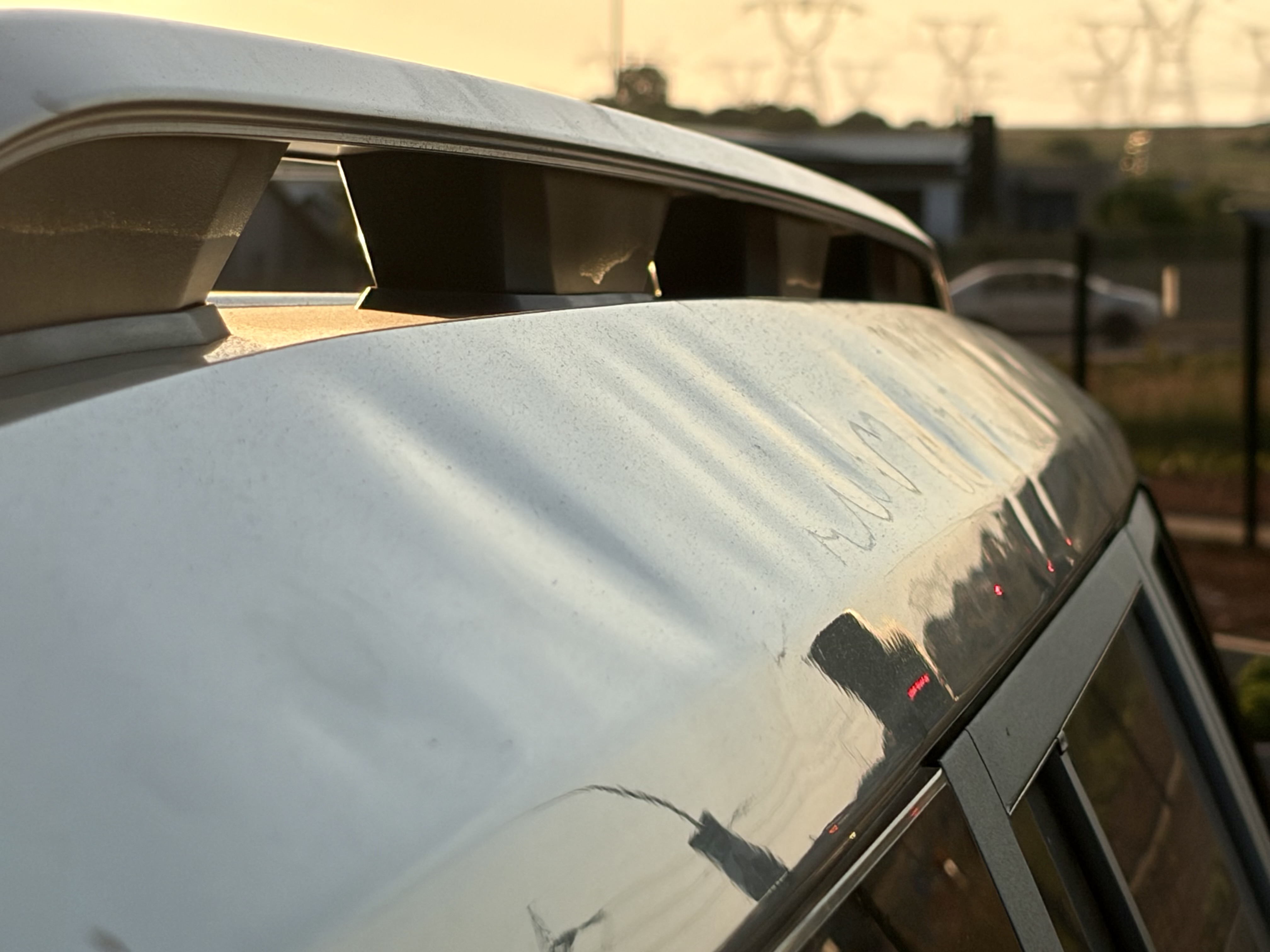

The AA recently received an alarming complaint from a member.
The member, an owner of a Jetour T1, presented the AA with documented evidence of “torsion rippling deformations (dents) in the roof side panels and around the margins/fringes of the panoramic sunroof” on his brand-new Jetour T1. The deformations surfaced while undertaking some mild weekend gravel off roading in the Dullstroom area. The member mentioned that nothing had ever been mounted, tied or affixed to the roof of the vehicle, and supported these claims through legally commissioned affidavits from parties present on the weekend.
The member appointed a senior independent vehicle assessor, with the feedback equally alarming and the assessor mentioning that “the consistency, orientation and repetition of the roof side panel rippling observed on this vehicle are both unusual and technically significant. In particular, the highly uniform 45-degree resonance pattern present along the left-hand roof side panel is a clear manifestation of internally generated torsional stresses acting within the vehicle's monocoque body structure, rather than the result of external influence or isolated panel irregularities”.
The assessor further found that the degree of local panel flexibility observed during the inspection, together with the repetitive deformation pattern, was not representative of the structural behaviour expected of a new vehicle and strongly suggests a deficiency in the stiffness characteristics of the upper roof side structure. The assessor concluded that the body shell, in the area inspected, does not exhibit the level of structural rigidity that would reasonably be expected of a vehicle of this age and specification, and that this condition warrants immediate engineering investigation by Jetour South Africa to determine the underlying manufacturing or design defect.
The assessor issued a further warning to other T1 owners, stating that “in my professional opinion, the deformation observed is sufficiently characteristic to raise concern that other Jetour T1 vehicles may exhibit similar stress-related deformation. I therefore recommend that the manufacturer conduct a fleet-wide engineering assessment to determine the prevalence and root cause of this condition.”
The Motor Industry Ombudsman of South Africa (MIOSA), after considering reports from both parties, sided with our member, mentioning that the complainant’s investigator “found that the indentations on the roof side panels and along both sides of the panoramic sunroof are not representative of normal structural behaviour for a new vehicle and are more consistent with a body shell stiffness or manufacturing-related defect than with external influence”.
MIOSA asked, in terms of Section 53 of the Consumer Protection Act, that the Chery Group brand “accept the vehicle into its stock and replace it with another similar vehicle of similar age and mileage”. The Chery Group appealed the ruling at the time, with MIOSA further mentioning that ‘defect’ means any material imperfection in the manufacture of the goods or components, or in performance of the services, that renders the goods or results of the service less acceptable than persons generally would be reasonably entitled to expect in the circumstances.
Following the AA publishing these findings, MIOSA reached out to our member confirming a Jetour offer which stipulated a vehicle refund, less costs for mileage based on an AA or SARS mileage rate. Jetour also offered to replace the vehicle as a like-for-like, i.e. similar spec, year-model and mileage. The AA advised our member that under no circumstances should he be penalised in any way for a deficient product which was purchased brand new.
The Chery group, after contesting our member’s independent assessor report and the MIOSA ruling against their favour, has now agreed to a buy-back of our member’s T1 at the full purchase price. No deductions will be incurred for usage, mileage or depreciation.
This is an absolute consumer win for our T1 owner, but it still does leave a few open-ended concerns.
The Chery group was anchored in its belief that our member, MIOSA, and the member’s independent assessor were wrong in their findings, refusing at the very outset to offer our member anything meaningful in terms of compensation, leading our member to MIOSA for mediation.
The AA therefore questions the Chery group, again, on the findings of this case, South Africa needs to know if these Chery group products are structurally defective – more so as:
- Our member was instructed to sign a non-disclosure agreement as part of the terms for the settlement.
- Chery group has been quoted as stating that “following an internal review, as well as the findings provided by MIOSA, Jetour South Africa has decided to proceed with the buy-back”. This implies that Jetour has accepted the MIOSA ruling in the member’s favour. MIOSA at the time quoted that the case was “not representative of normal structural behaviour for a new vehicle and more consistent with a body shell stiffness or manufacturing-related defect than with external influence”.
- The AA understands that the National Regulator for Compulsory Specifications (NRCS) has implemented a full audit of compliance against Jetour SA.
Other AA concerns with the Chery group include:
- The validity of the NRCS approval of the updated payload (load-carrying) capacity of 475kg, inclusive of the driver, for the Jetour T1 and T2 passenger vehicles. The concerns raised by the AA are threefold: the validity of the revised payload figures from an initial rating of 300kg to 475kg (with no mechanical upgrades), the fact that the rating applies to new and existing models on our roads, and that the NRCS grants these approvals based on global lab reports submitted by the automaker, as opposed to local and independent verification.
- The NRCS confirmed that Jetour’s application for the revised payload rating for the T1 is still in the approval process, meaning that both new and existing T1 customers are still subject to the vehicle’s original homologated payload rating of 300kg. This contradicted what the automaker stated a few weeks prior, claiming at the end of August that “based on the approval obtained from the NRCS, Jetour South Africa confirms that the approved payload capacity applicable to the relevant Jetour T1 and T2 model range is 475 kg, inclusive of the driver”. The AA maintains that increasing a payload by almost 200kg (58% increase) with no attention to structural integrity remains a safety concern for local owners.
- The NCC has confirmed the recall of more than 23,000 Chery and Omoda vehicles for a rear-axle welding fault on the Tiggo 4 and Omoda C5 and a brake pipe that can wear against the turbocharger on the Tiggo 8 Pro Max. The NCC has further confirmed that Chery has effectively been running what it calls silent recalls. On 25 June, Chery told its dealers to treat the campaign as a priority, contact affected customers and check unsold stock. The public was not told until the NCC’s notice on 10 November, 138 days later. The NCC has now said publicly that it is investigating Chery over allegations of earlier recalls that were not reported to it.
“While this is a great outcome for our member, we cannot help but wonder why the sudden change of stance from the Chery group. Combine this with muzzling our member and we’re left wondering what the Chinese automaker is trying to hide here,” says Bobby Ramagwede, CEO of the Automobile Association of South Africa.
“We call on all Chery group owners to reach out to us with concerns not being resolved by your local dealers. Our internal data has in the last year shown worrying reliability trends for the group, which when paired with the payload and structural concerns surrounding Jetour customers raises massive red flags for the AA.
“We also remind T1 and T2 customers who are displaying licence discs showing 300kg payload ratings to be cognisant of the repercussions going into the holiday season. Legally you are bound to obey that payload rating, while from a safety point of view we reiterate that the claimed increased rating, without mechanical upgrades, poses a significant safety risk for families looking for safe passage. Owners could be putting their families at risk, while authorities at roadblocks will work according to licence disc stipulations”.
The AA asks the South African motorist to prioritise safer mobility. The AA strives for the safety and wellbeing of the South African motorist, if you are a member and have a consumer issue that is in need of our urgent mediation, please email
Become a member today and help us help you.