


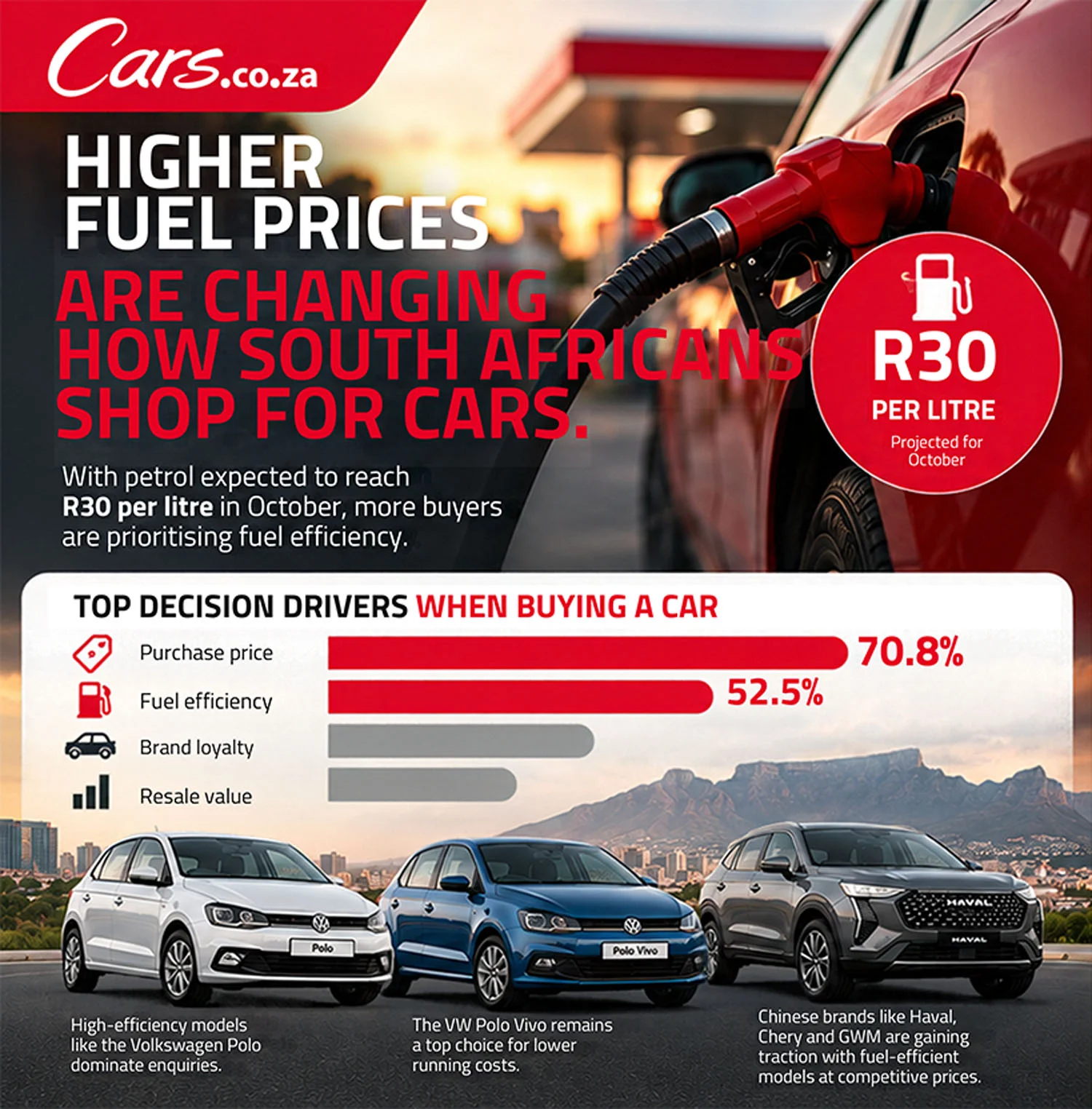
With October fuel-price adjustments projected to push inland 95-unleaded petrol close to the R30-per-litre threshold, South African motorists are fundamentally re-evaluating their transport budgets.
However, new platform data from Cars.co.za reveals that rather than putting vehicle purchases on hold, sustained fuel price volatility is actively reshaping how consumers shop – accelerating consideration for hybrids, smaller-engine vehicles and affordable new-energy alternatives.
The budget shift: From purchase price to total cost of ownership
According to the Cars.co.za Industry Report 2026, macroeconomic pressures have elevated fuel efficiency to a non-negotiable buyer priority. A survey of active car buyers captured on the platform found that fuel efficiency (52.5%) is now second only to purchase price (70.8%) as the primary decision driver when selecting a vehicle, outranking traditional considerations like brand loyalty or resale value.
This crunch on household liquidity is changing consumer behaviour across both new and pre-owned vehicle segments:
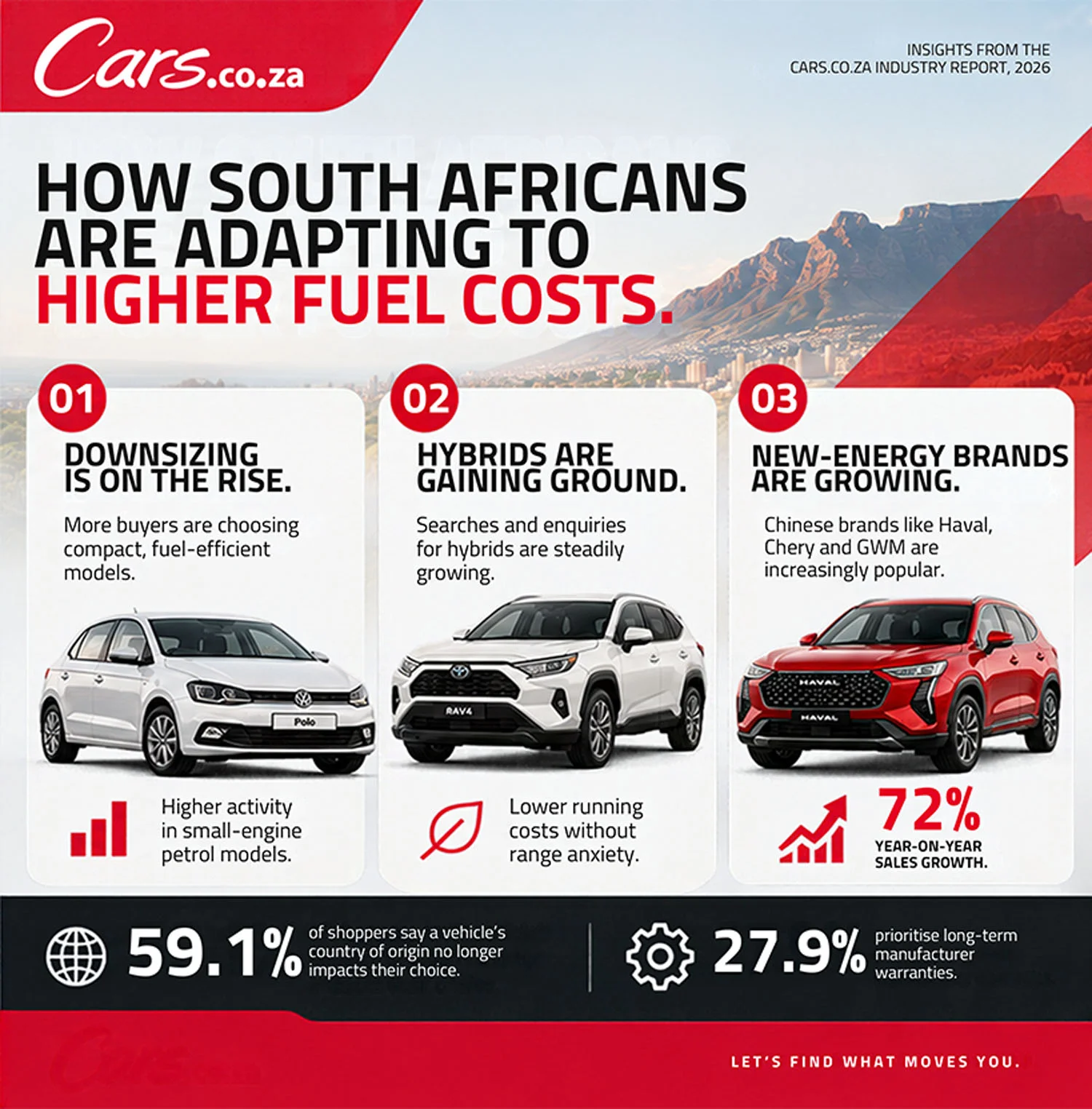
- The downsizing trend: Enquiries on Cars.co.za show growing activity in compact, small-capacity petrol models. High-efficiency compact cars such as the Volkswagen Polo and VW Polo Vivo continue to dominate overall lead volume, with buyers prioritising lower consumption over larger engine displacements.
- Hybrid momentum: While full battery electric vehicles (EVs) continue to face adoption hurdles related to initial purchase price and public charging infrastructure challenges, hybrid vehicles have emerged as the pragmatic middle ground. Search and enquiry activity for petrol-electric hybrids has seen steady quarter-on-quarter growth, driven by buyers seeking reduced fuel-per-kilometre running costs without range anxiety.
- Emergence of value-driven new-energy brands: Chinese automakers are playing a central role in democratising lower running-cost vehicles. With Chinese automotive inventory expanding on Cars.co.za and sales surging 72% year-on-year, brands like Haval, Chery and GWM are offering feature-dense, fuel-efficient crossover models at price points that directly compete with traditional entry-level vehicles. Cars.co.za platform data reveals 59.1% of surveyed shoppers say a vehicle’s country of origin no longer impacts their choice, paving the way for rapid adoptability of affordable hybrid and small-displacement alternatives.
Expert commentary: The total cost of ownership calculation
Commenting on the shifting landscape, Alan Quinn, Chief Innovation and Product Officer at Cars.co.za, says:
"When petrol moves closer to R30 a litre, the monthly cost of running a vehicle rapidly rivals the monthly finance payment itself. What we are seeing on Cars.co.za is a clear transition toward a 'total cost of ownership' mindset. Everyday motorists are doing the math – weighing up cost per kilometre, fuel economy figures and remaining service plans just as heavily as the ticket price.
"It’s important to recognise that this isn't solely an EV transition story," Quinn adds. "While full electric vehicles are growing, the immediate relief for most South Africans comes from pragmatic alternatives, whether that’s switching to a self-charging hybrid, choosing a modern 1.0-litre turbocharged petrol engine or looking at competitive value propositions from new market entrants. Consumers are using our platform tools to find practical ways to hedge against the next pump price hike."
Looking ahead: What will drive the next phase of buyer behaviour?
As motorists navigate ongoing cost pressures, several key factors are expected to influence vehicle selection over the coming 12 months:
- Financing and flexible mobility: With 53% of South African consumers actively cutting back on discretionary spending, flexible finance structures, balloon payment considerations and total monthly operating costs will remain central to buying decisions.
- Expanding hybrid and EV variety: As more accessible hybrid powertrains and entry-level EVs enter the market – supported by expanding long-term manufacturer warranties (a factor prioritised by 27.9% of shoppers) – consumer confidence in non-traditional powertrains is set to deepen.
- Digital research and real-world evaluation: With 35.2% of consumers relying on video and written reviews, plus 35.3% placing ultimate reliance on test drives, hands-on verification of real-world fuel economy will continue to guide final purchase decisions.